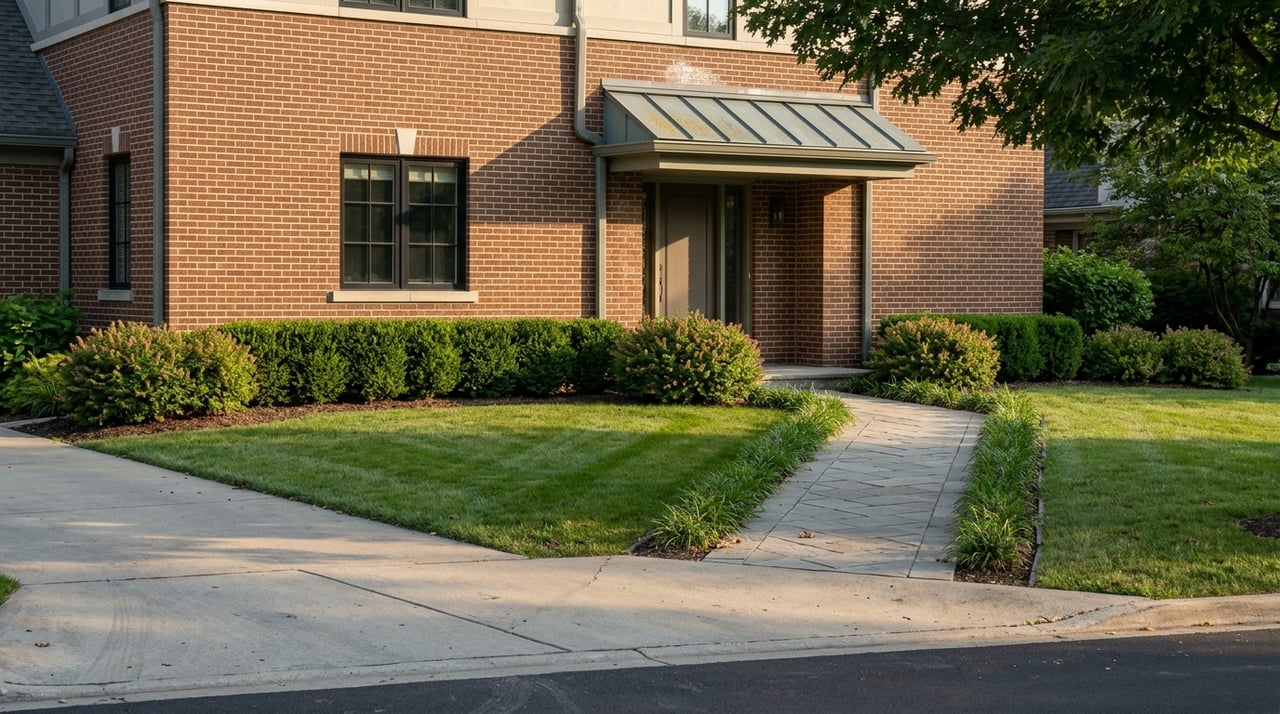
Mital Gandhi built his backyard for basketball games, cookouts by the fire pit, and pool days with his kids. Thirteen years after he moved into the Regency subdivision off Waxpool Road, it still works that way, most of the time. Then there's the sound that isn't bass from a neighbor's speaker. It's the two data centers flanking his 143-home community, running around the clock. "We are the epicenter of the internet," Gandhi told a Washington-area news crew this summer, standing by his pool.
That single sentence captures the strangest fact about buying a home in Ashburn right now. Every serious study of Loudoun County's housing market says proximity to data centers has not hurt prices. The people who live closest to the biggest concentration of them on the planet are, in some cases, trying to sell their entire neighborhood and leave.
Both things are true. A buyer weighing Ashburn against another Northern Virginia suburb needs to understand why, because the county-level number and the block-level reality are answering two different questions.
What the county-wide data actually says
If you pull up Ashburn's numbers this summer, nothing looks alarming. Redfin put the median sale price at $699,619 as of June 2026, down a modest 0.76 percent year over year. Zillow's broader Ashburn average sat at $801,415 as of August 2026, down just 0.4 percent over the past year. Back in March 2026, Redfin recorded homes selling in a median of 19 days, down from 22 days the year before, with 45 homes sold that month compared to 36 in March 2025. That's a market holding steady, not one buckling under industrial neighbors.
A George Mason University analysis went further and asked the question directly: do data centers depress nearby home prices? Researchers looked at home-sale and location data across Loudoun County and found the opposite pattern from what most buyers assume. Prices generally rose as distance to a data center decreased. Terry Clower, the Northern Virginia economist who co-authored the study, has pointed to another reason the county's homeowners come out ahead in aggregate: the extraordinary assessed value data centers add to the tax base means the average Loudoun household pays less in property taxes than residents of surrounding counties, a benefit that shows up on every tax bill whether or not a given house sits next to a facility.
So the county-wide story is genuinely reassuring. It's also incomplete, because it averages together thousands of homes that experience data center proximity in completely different ways.
The Regency problem the averages can't see
Regency sits inside what locals call Data Center Alley, flanked on two sides by facilities. Gandhi, a former HOA president, has spent years pushing back on noise and construction, calling zoning offices and pressing for sound readings. Eventually he concluded the fight wasn't winnable and pivoted to a different plan entirely: sell every home and acre to a data center operator and let the whole subdivision become what it already borders.
The numbers behind that plan are worth sitting with. A developer reportedly began offering Regency homeowners around $4.4 million per acre to assemble a roughly 130-acre site in March 2026, according to trade reporting on the deal. Homeowners have discussed cashing out for a reported $4 million each, a figure that lines up with the acreage math if the assemblage goes through as planned.
That kind of payout sounds like proof the market has priced in the proximity premium the George Mason study found. But Regency's situation also shows the limits of that premium as a strategy. According to WUSA9, even with all 143 homeowners on board, Loudoun County supervisors still have to approve rezoning the land for data center use, and that approval is not automatic. According to Web & IT News, Loudoun removed by-right zoning for data centers back in 2024, which means every new facility now goes through case-by-case review rather than an approval the developer can count on.
In other words, living next to Data Center Alley doesn't guarantee a buyout offer, and even a strong offer doesn't guarantee the rezoning that would make it real. Regency's residents are, for now, stuck with the hum while they wait on a county process that could take years or could fail outright.
Why the premium and the pain both hold up
The reconciliation is simpler than it sounds. A George Mason style study looking at Loudoun County as a whole picks up the broad economic effect: data centers bring jobs, tax revenue, and a steady draw of high-income buyers who want to live near their employer's infrastructure. That effect is real and it lifts prices across the county, including in neighborhoods that never hear a generator.
What the county average can't isolate is the experience of the specific parcels sitting closest to an active campus, close enough to catch the noise, the visual footprint, and the construction traffic without necessarily capturing the same employment draw that lifts prices across the wider corridor. Amazon's purchase of George Washington University's roughly 120-acre former Ashburn campus for $427 million this year, at close to $3.5 million per acre, is a large land transaction in eastern Loudoun. That market-scale event is distinct from the day-to-day experience of one of the 143 households whose backyard now borders an active campus.
This is also why comparing Ashburn's two ZIP codes tells you less about data centers than it seems to. Zillow's typical home value for 20148, the newer Brambleton corridor with its Metro-adjacent development, ran $817,687 in the spring of 2026, meaningfully above the broader Ashburn average. That gap tracks with newer construction and Silver Line access, not with which ZIP code has more data centers, since facilities cluster throughout both. Reading a ZIP-level price gap as proximity risk would be the wrong lesson from the right data.
What this means if you're comparing a specific address
The practical takeaway for a buyer isn't to avoid Ashburn, and it isn't to treat the George Mason findings as a blanket green light either. It's to stop asking the county-level question and start asking the block-level one for any specific property you're seriously considering.
A few checks worth doing before you write an offer near any facility:
- Search Loudoun County's planning applications for the parcel and its immediate neighbors, since an approved facility today doesn't rule out an expansion filing next year
- Look for utility interconnection requests tied to the site, which often signal planned capacity growth before construction crews show up
- Read recent Board of Supervisors meeting minutes for the district
- Drive the street at different times of day, including evening, since cooling systems and backup generators run on their own schedule, not the seller's showing schedule
None of that shows up on a portal listing page, and none of it would have told Mital Gandhi what was coming thirteen years ago. It's exactly the kind of homework a buyer's agent who knows the county's rezoning process can help you do before you're the one deciding whether a hum is a dealbreaker or background noise.
A few questions worth asking directly
Does living near a data center always increase home value? Not automatically, and not evenly. The county-wide pattern favors proximity, but the benefit is concentrated in employment and tax effects that don't fully reach the handful of properties closest to an active or expanding facility.
Are all Ashburn neighborhoods equally exposed? No. Data centers cluster in specific corridors rather than spreading evenly across 20147 and 20148, which is why checking the parcel and its neighbors matters more than checking the ZIP code average.
Should I rule out buying near Data Center Alley entirely? That's a personal tolerance question as much as a financial one. The price data doesn't support broad avoidance, but a property backing directly onto an active campus is a different purchase than one well outside the immediate corridor, and it deserves the diligence to match.
If you're weighing an Ashburn address against something in Leesburg, Broadlands, or across the county line, the Susan & Joe Team can walk the specific parcel history with you, not just the neighborhood average. Start the conversation and let's look at what the county filings actually say about the block you're considering.
This article is general information, not legal, tax or financial advice. Consult a qualified professional about your situation.